
Section 206 for Westchester LLCs (2026 Guide)
Section 206 of the New York Limited Liability Company Law requires every Westchester County LLC to publish a notice of formation in two newspapers designated by the Westchester County Clerk — one daily, one weekly — for six consecutive weeks. The full process, including filing the Certificate of Publication with the NY Department of State, must be completed within 120 days of the LLC's effective formation date. The state filing fee is $50; total Westchester publication cost runs $250–$450 DIY or $385 with our flat-fee service — no recurring fees, no county changes, no registered-agent subscription required.
This guide explains Section 206 specifically as it applies to Westchester County LLCs: which Westchester newspapers qualify, what the Westchester County Clerk does, Westchester-specific costs and timelines, and what happens if a Westchester LLC misses the deadline.
What Is Section 206 of the New York LLC Law?
Section 206 is the specific statute within the New York Limited Liability Company Law that governs the publication requirement. Its official title is "Affidavits of Publication," and it sits within Article 2 (Formation) of the LLC Law.
In plain English, Section 206 says: after you form your LLC in New York, you must publicly announce its existence through legal notices in designated newspapers. You then prove you did this by filing paperwork with the state.
This is not optional. It is a mandatory step in forming a New York LLC, separate from filing your Articles of Organization. Filing your articles creates the LLC. Publishing under Section 206 satisfies an additional transparency requirement that New York imposes on LLCs.
Section 206 for Westchester LLCs at a Glance
- What: Publish notice of LLC formation in two newspapers designated by the Westchester County Clerk
- Where: In the county on the LLC's NY DOS record (Westchester, for Westchester-designated LLCs)
- Duration: Once per week for six consecutive weeks in both newspapers
- Deadline: 120 days from the effective date of the Articles of Organization
- Final step: File the Certificate of Publication (Form DOS-1708) with the NY Department of State
- State filing fee: $50
- Total Westchester cost: $250–$450 DIY; $385 with our flat-fee service
- Westchester County Clerk: (914) 995-3070, 110 Dr. Martin Luther King Jr. Blvd, White Plains
Westchester Section 206 Quick Stats
Why Does Section 206 Exist?
The publication requirement dates back to the original New York LLC Law. The stated purpose is consumer protection — putting the public on notice that a new business entity has been formed that shields its owners from personal liability.
The New York County Lawyers Association, in a 2006 letter to Governor George Pataki, described the requirement as "antiquated" but acknowledged its original intent: "publication of the notice of formation ostensibly serves to put the public on notice that an entity has been formed to do business... within a corporate structure that shields its owners from personal liability."
The rationale is straightforward. When someone forms an LLC, the people they do business with should have a way to know that they are dealing with a limited liability entity — not an individual who is personally responsible for debts and obligations.
Whether newspaper publication still accomplishes this goal in the internet age is widely debated. Critics — including the New York Attorney General, who called the requirement "costly and unnecessary" — point out that LLC formation information is already publicly available through the Department of State's online database. Despite this criticism, the legislature has kept the requirement in place.
A Requirement That Only Applies to LLCs
Notably, New York corporations do not have a publication requirement. Only LLCs (and certain partnerships) must publish. Legislators have pointed out this inconsistency, noting that "there are no similar requirements in the Business Corporation Law." This is one of the main arguments critics use when calling for repeal.
Who Must Comply with Section 206 in Westchester County?
Every domestic LLC designated in Westchester County must comply with Section 206. That includes every LLC whose Articles of Organization list Westchester County as the county where the office is located. There are no exceptions based on:
- Business size (single-member or multi-member Westchester LLCs)
- Revenue or number of employees
- Industry or business type (a Westchester restaurant LLC, a Yonkers consulting LLC, a White Plains real-estate LLC — all must publish)
- Whether the LLC is actively conducting business
Professional LLCs (PLLCs) designated in Westchester must comply too — they use Form DOS-1709 instead of Form DOS-1708 but the publication requirement is identical. Foreign LLCs registering in Westchester County under Section 802 of the LLC Law have a parallel publication requirement.
The one narrow exemption: Theatrical production companies that include the words "limited liability company" in their name are exempt from the publication requirement under Section 23.03 of the Arts and Cultural Affairs Law.
Westchester Designation Determines Where You Publish
Section 206 ties publication to the county on the LLC's DOS record at the time of publication — not where the business operates day-to-day, not where the owner lives, not where the LLC was originally formed in any other state. If your Articles of Organization list Westchester County, you publish in Westchester-designated newspapers, period. We don't change that designation; we publish where the LLC is.
What Must Be Included in the Publication Notice?
Section 206 specifies exactly what information the published notice must contain:
- The name of the LLC — exactly as filed with the Department of State
- The date of filing of the Articles of Organization (and the date of formation, if different)
- The county where the LLC's office is located
- The street address of the principal business location, if any
- A statement that the Secretary of State has been designated as the LLC's agent for service of process, along with the mailing address for forwarding process
- Registered agent information — the agent's name and address, if the LLC has designated one
Getting this information right matters. If the notice contains errors — especially in the LLC name or filing date — it can create problems when you file your Certificate of Publication with the Department of State. For a full list of pitfalls to watch for, see common LLC publication mistakes.

The 120-Day Deadline
The 120-day clock starts on the effective date of your Articles of Organization. This is typically the date the Department of State processes your filing, which appears on your filing receipt.
Within that 120-day window, you must:
- Obtain your newspaper designation from the county clerk
- Place and run the notice in both newspapers for six consecutive weeks
- Collect affidavits of publication from both newspapers
- File the Certificate of Publication with the Department of State
Since the publication alone takes six weeks (42 days), and newspaper coordination, affidavit collection, and state processing add several more weeks, the practical timeline is 8-10 weeks. That means you have roughly 7 weeks of buffer if you start promptly — but delays can eat into that cushion fast.
Start Early
Starting the publication process within two weeks of forming an LLC is advisable. Waiting until month three of the 120-day window leaves almost no room for delays in newspaper designation, publication scheduling, or affidavit collection.
What Happens After Publication Is Complete?
Once both newspapers have run your notice for six consecutive weeks, each one provides an affidavit of publication — a sworn statement confirming the notice ran as required.
You then file a Certificate of Publication with the New York Department of State. The filing package includes:
- The completed Certificate of Publication form
- Both affidavits of publication (attached)
- A $50 filing fee
The Department of State reviews the filing, confirms the LLC name and dates match their records, and processes it. Once approved, your LLC has fully satisfied the Section 206 requirement.
What Happens If You Miss the 120-Day Deadline?
Missing the deadline does not dissolve your LLC. Under Section 206, your LLC's authority to carry on, conduct, or transact business in New York is suspended.
However, the statute is clear about what suspension does not do:
- Contracts remain valid — Any agreements your LLC has entered into are still enforceable
- Liability protection stays intact — Members, managers, and agents do not become personally liable for the LLC's obligations
- Your LLC can still defend lawsuits — The right to defend actions and proceedings in New York courts is preserved
What suspension does affect:
- Your LLC cannot initiate lawsuits in New York state courts until publication is completed — see what happens if you don't publish your LLC for more detail
- You may not be able to obtain a Certificate of Good Standing — which banks, partners, and vendors sometimes require
New York courts have addressed §206 noncompliance in several decisions. In Barklee Realty Co. LLC v. Pataki (1st Dep't, 2003), the court upheld the constitutionality of the publication statute. More directly on the cure question, in Acquisition America VI, LLC v. Lamadore (5 Misc.3d 461, Civ. Ct. N.Y. County, 2004), the court held that §206 noncompliance is a jurisdictional defect that requires dismissal of any suit the noncompliant LLC has filed; the court rejected the argument that the LLC could "cure" mid-litigation by completing publication after filing suit. The Second Department reached a similar result in Small Step Day Care, LLC v. Broadway Bushwick Builders, L.P. (137 A.D.3d 1102, 2d Dep't 2016), affirming dismissal where the LLC had not completed publication before bringing suit.
Administrative Cure vs. Litigation Cure
For administrative purposes — restoring your LLC's good standing on the NY DOS record, obtaining a Certificate of Good Standing, day-to-day banking and contracting — late publication works. NY DOS processes Certificate of Publication filings without imposing a penalty for missing the 120-day deadline; once your filing is processed, the administrative suspension is lifted. The process and cost are the same whether you are on time or years late.
For litigation, complete publication before filing any lawsuit in the LLC's name — a few NY courts have held that suing during the §206 suspension is a jurisdictional defect that requires dismissal (see Lamadore and Small Step above). For specific litigation situations, consult a qualified New York attorney.
Has Anyone Tried to Repeal Section 206?
Yes — repeatedly. Bills to eliminate the publication requirement have been introduced in multiple legislative sessions:
- 2019-2020: Senate Bill S3361 and Assembly Bill A7642
- 2021-2022: Senate Bill S1481 and Assembly Bill A2551
- 2025-2026: Senate Bill S6483 and Assembly Bill A3546
The 2025-2026 bill (A3546) would eliminate the publication requirement entirely and establish a "Department of State modernization fund" to develop digital alternatives to physical newspaper publication.
Sponsors of these bills have argued that the requirement is "both unnecessary and very expensive — sometimes prohibitively so" and that designated newspapers hold "an effective monopoly in setting the charges for notices." They note that the Department of State already maintains a publicly accessible online database containing all LLC formation information.
Despite broad support for repeal from attorneys, business groups, and even the Attorney General's office, these bills have not passed. As of February 2026, Section 206 remains fully in effect, and every New York LLC must comply.
How Section 206 Applies in Westchester County
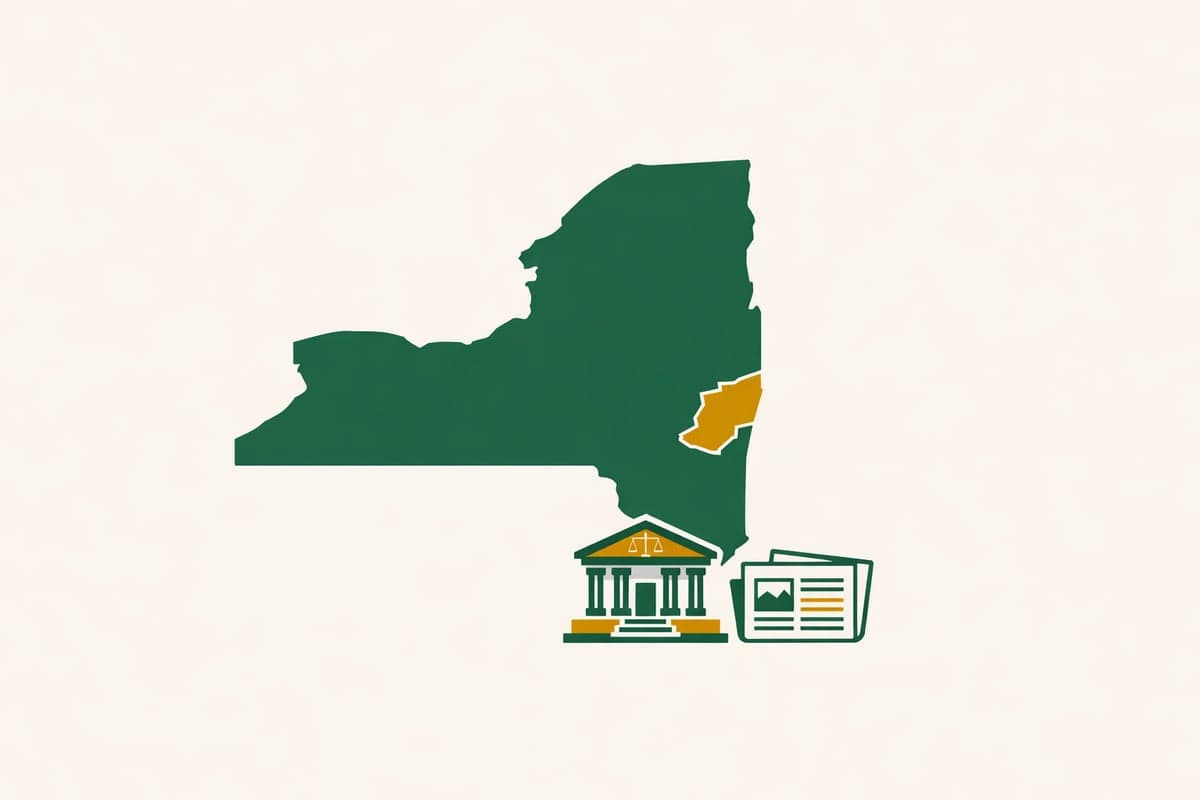
If your LLC lists Westchester County as its county of office on the Articles of Organization, Section 206 requires publication in two newspapers designated by the Westchester County Clerk — one daily and one weekly. Here is exactly what Section 206 compliance looks like for a Westchester County LLC:
1. Westchester County Clerk Designation
The Westchester County Clerk's office maintains a public list of newspapers approved for LLC publication notices. Currently the clerk designates 4 daily newspapers and 21 weekly newspapers for Westchester. Unlike NYC boroughs (where the clerk assigns specific newspapers per LLC), Westchester lets the LLC owner choose one daily and one weekly from the approved list — see our complete Westchester County designated newspapers guide for the current list.
- Office: 110 Dr. Martin Luther King Jr. Blvd, White Plains, NY 10601 (entrance via Richard J. Daronco Courthouse, 111 Dr. MLK Jr. Blvd)
- LLC publications phone: (914) 995-3070
- Hours: Monday–Friday, 8:30 AM – 4:30 PM
- Online list: westchesterclerk.com/about/designated-newspapers
2. Six Consecutive Weeks of Publication
The notice runs once per week for six consecutive weeks in both the daily and the weekly newspaper. That's the statutory minimum and there is no shortcut. A missed week means the count restarts, so monitoring publication weekly is critical.
3. Affidavits of Publication
After the six-week run, each newspaper provides a sworn affidavit of publication — typically delivered 1–2 weeks after the final insertion. You need both affidavits before you can file the Certificate of Publication.
4. Certificate of Publication Filing
You file Form DOS-1708 with the NY Department of State, attach both affidavits, include the $50 filing fee, and mail to:
New York Department of State Division of Corporations One Commerce Plaza 99 Washington Avenue Albany, NY 12231
Standard processing is 2–4 weeks; expedited options run $25 (24-hour) to $150 (2-hour).
5. Westchester-Specific Cost
Total Westchester Section 206 cost:
- DIY: $250–$450 total (newspaper fees $200–$400 + $50 DOS filing fee)
- Our flat-fee service: $385 all-inclusive (both newspapers, affidavits, $50 DOS fee)
- NY Law Journal: $1,200–$2,000+ (designated but unnecessarily expensive)
For the complete cost analysis, see how much Westchester LLC publication costs.
6. Timeline
The practical Westchester Section 206 timeline runs 8–10 weeks from start to finish, well within the 120-day deadline if you start promptly. See our step-by-step Westchester publication guide for the week-by-week breakdown.
A Westchester-Designated LLC Doesn't Need a County Change to Comply
Section 206 ties publication to the county on the LLC's DOS record at the time of publication. For a Westchester-designated LLC, that's already Westchester — no county change is required to satisfy the statute. Some bundled services involve filing a Certificate of Change to update your LLC’s county designation as part of registered-agent signup; those changes are not required to complete Section 206 publication. They are a consequence of the provider's business model being concentrated in one county. See should I publish in Albany instead of Westchester for the full analysis.
Westchester County's moderate publication costs, flexible newspaper selection from a 25-paper designated list, and accessible county clerk make it one of the more straightforward counties for completing Section 206. We publish where your LLC is already designated; we don't change your county, registered agent, or service-of-process address.
Changes During or After Publication
Section 206 addresses a practical concern: what happens if your LLC's information changes while the notice is running?
If a change occurs after the first weekly publication but before the sixth, the statute says you may complete the remaining publications of the original notice. You do not need to start over or publish an amended notice.
If a change occurs after all six publications are complete, no further publication or republication is required.
This is important because LLC details can change — for example, a change of registered agent address or principal business location. Section 206 was designed so that these mid-process changes do not force you to restart the clock.
If you do need to make changes to your LLC's information filed with the Department of State, that is handled through a separate Certificate of Change — a different process from publication.
Frequently Asked Questions
What is Section 206 of the New York LLC Law?
Section 206 is the statute in the New York Limited Liability Company Law that requires every LLC designated in any New York county to publish a notice of formation in two newspapers designated by the county clerk — one daily, one weekly. For a Westchester-designated LLC, that means publishing in two newspapers approved by the Westchester County Clerk. The notice runs once per week for six consecutive weeks, and the Certificate of Publication (Form DOS-1708) must then be filed with the NY Department of State within 120 days of the LLC's effective formation date.
Does Section 206 apply to single-member LLCs in Westchester?
Yes. Section 206 applies to every LLC designated in Westchester County regardless of the number of members. Single-member Westchester LLCs, multi-member Westchester LLCs, and professional LLCs (PLLCs) designated in Westchester must all comply.
What is the penalty for not complying with Section 206?
There is no fine or monetary penalty. Instead, your LLC's authority to conduct business in New York is suspended. This primarily means your LLC cannot initiate lawsuits in New York state courts and cannot obtain a Certificate of Good Standing. Contracts remain valid, liability protection remains intact, and you can cure the suspension at any time by completing Westchester publication and filing the Certificate of Publication. See missed publication deadline in Westchester for the full recovery process. For specific questions about how suspension may affect your situation, consult with a qualified attorney.
Can I complete Section 206 publication after the 120-day deadline?
Yes. You can complete Westchester publication at any time after the deadline. Once you file your Certificate of Publication with the NY Department of State, the suspension of your LLC's authority is annulled. There is no late penalty fee, and the cost is identical to on-time publication ($250–$450 DIY or $385 with our flat-fee service).
Why doesn't New York require corporations to publish?
This is one of the most common criticisms of Section 206. New York's Business Corporation Law does not contain a similar publication requirement for corporations. The LLC publication requirement has been called an inconsistency by legislators and legal commentators. Multiple repeal bills have cited this disparity as a reason to eliminate the requirement, but as of 2026, it remains in place for every Westchester County LLC.
Do I need a lawyer to comply with Section 206 in Westchester?
No. Publication is an administrative process, not a legal proceeding. You can handle Westchester publication yourself, hire a flat-fee specialist like us, or have an attorney manage it. Most Westchester LLC owners do not need a lawyer for this step — see DIY vs. publication service in Westchester. For unusual situations (mid-publication LLC name changes, contested registered-agent designations), consulting an attorney is reasonable.
How much does Section 206 publication cost in Westchester County?
DIY publication in Westchester typically costs $250–$450 total (newspaper advertising fees of $200–$400 + $50 NY DOS filing fee). Our flat-fee service costs $385 all-inclusive — both newspapers, six weeks of publication, affidavit collection, Certificate of Publication filing, and the $50 DOS fee. No recurring fees, no county changes, no registered-agent subscription. See the full Westchester LLC publication cost breakdown.
Is there any way to avoid the Section 206 publication requirement?
For practical purposes, no. The only exemption is for theatrical production companies whose name includes "limited liability company" (Section 23.03 of the Arts and Cultural Affairs Law). Every other LLC designated in Westchester must comply. Some bundled services offer to change your LLC's county designation to Albany or Rockland — Section 206 publication still applies, just in the new county at the new (typically lower) rates. The county change itself is a separate filing under §211-A with its own fee, and most bundled services attach an ongoing registered-agent subscription. See should I publish in Albany instead of Westchester for the full analysis.
Which newspapers are designated for Section 206 publication in Westchester?
The Westchester County Clerk currently designates 4 daily newspapers and 21 weekly newspapers for Section 206 publication. The dailies are: The Journal News, Hamodia Daily, National Herald, and the New York Law Journal. The 21 weeklies range from cost-effective community papers (Rivertowns Enterprise, Scarsdale Inquirer, Hometown Media Group papers) to higher-rate trade publications (Westchester County Business Journal, Westchester Law Journal). See the complete list with contact info at Westchester County designated newspapers.
Does my Westchester LLC need a registered agent to comply with Section 206?
No. New York does not require LLCs to appoint a paid registered agent — the Secretary of State automatically serves as the agent for service of process. Some publication services bundle a registered-agent subscription because their business model uses the provider's address as your LLC's county of office (typically Albany or Rockland), which requires a registered-agent change. A specialist Westchester publication service uses your existing Westchester designation; no registered agent change is required, no subscription is required.
Westchester County LLC Publication Service
I am Jasmine Kohli, and we specialize in Westchester County LLC publication. Our $385 flat fee covers every step that Section 206 requires — newspaper designation, six weeks of publication, affidavit collection, Certificate of Publication filing, and the $50 DOS fee. No county changes, no registered agent subscription, no recurring fees. Compare our service against other options in the best LLC publication services guide, or browse all articles for more information.
Learn how the process works | Start your publication | Contact us with questions
Ready to publish? $385 covers everything.
Westchester County’s specialist LLC publication service. Direct phone: (631) 681-5298. 100% money-back guarantee if your Certificate of Publication isn’t delivered. We publish in Westchester — your LLC stays exactly as you set it up: same county, same registered agent, same service-of-process address.
Start your Westchester LLC publication → | Get pricing | Have questions?
Disclaimer
The information in this article is for general informational purposes only and does not constitute legal advice. While we strive for accuracy, laws and procedures may change. For specific legal questions about your LLC, consult with a qualified attorney. Westchester County LLC Publication provides publication services and administrative filing assistance — I am not a law firm and cannot provide legal advice.